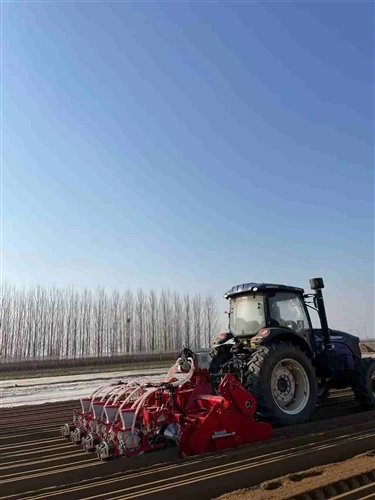
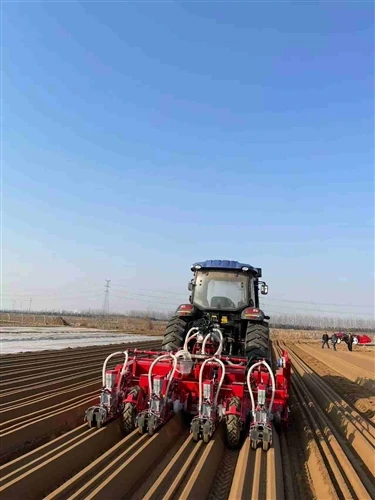
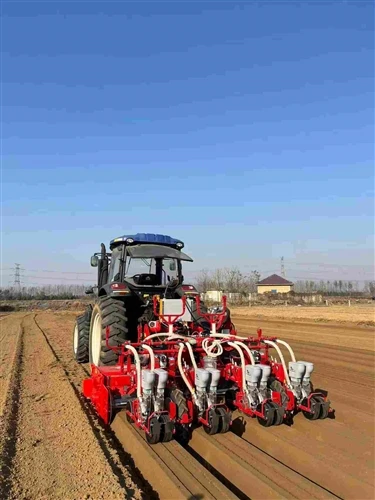
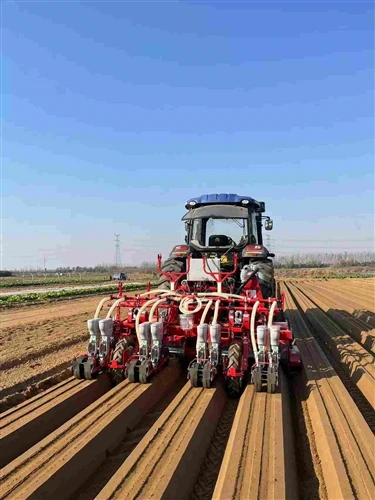
Ask any experienced vegetable grower about the most tedious part of production, and many will mention thinning and transplanting. These labor-intensive tasks are traditionally necessary because mechanical seeders and broadcasting methods cannot place seeds at precise intervals. The result is overcrowded seedlings that must be manually separated, or gaps that must be filled with transplants. An air-suction vegetable seeder eliminates most of this work.
The problem starts with how conventional seeding methods distribute seeds. Broadcasting scatters seeds randomly across the field. Mechanical seeders often drop multiple seeds at one point or skip points entirely. In both cases, the grower must later walk the field, remove excess seedlings, and fill gaps. This work is slow, expensive, and difficult to organize as labor supplies tighten.


Vacuum-based precision seeding changes the equation. An air-suction vegetable seeder picks up one seed per hole and places it at the precise spacing required for the crop. The result is a uniform plant stand from the moment of emergence. There is no need to thin overcrowded clusters because there are no overcrowded clusters. There is no need to fill gaps because there are no gaps.
For onion growers, this is a major improvement. A pneumatic onion planter can place onion seeds at the exact spacing required for optimal bulb development. The onions emerge uniformly and grow without competition from neighboring plants. The grower saves the cost of thinning labor and gains a more predictable harvest.


Carrot growers see similar benefits. An air-suction carrot planter that maintains uniform spacing prevents the misshapen or undersized roots that result from overcrowding. The carrots grow straight and uniform, meeting the quality standards that buyers demand.
The benefits extend beyond labor savings. Uniform plant stands simplify every subsequent operation. Fertilization can be applied evenly because every plant has similar needs. Pest and disease control becomes more predictable because the canopy develops uniformly. Mechanical weeding causes less crop damage because the plants are where the equipment expects them to be.
The technology behind this precision is well established. Negative-pressure air-suction metering creates a vacuum chamber within the seed metering unit. Seeds are drawn onto the micro-pores of a rotating seed disc and transported to the release point. The vacuum-based pickup process also minimizes mechanical damage to the seeds, preserving their germination potential.

For growers who have spent years thinning and transplanting by hand, the transition to an air-suction vegetable seeder can feel like a revolution. The machine does in one pass what previously required multiple field operations and weeks of manual labor. A vegetable seeder that places one seed per hole at the correct spacing is not just a planting tool-it is a labor-saving system that changes the economics of vegetable production.
Whether planting onions, carrots, lettuce, or other small-seeded vegetables, the right pneumatic vegetable planter can eliminate the need for thinning and transplanting. The result is lower costs, more consistent crops, and a more manageable planting season.