

Hybrid vegetable seed prices have risen sharply in recent years, putting pressure on growers to use every seed efficiently. For crops such as onions, carrots, and lettuce, where hybrid varieties dominate the market, seed cost can represent a significant share of total production expenses. This economic reality is driving renewed interest in air-suction vegetable seeders, which allow growers to place exactly one seed per hole and eliminate the waste associated with traditional mechanical seeding.
The math is straightforward. A mechanical seeder planting onion seed may drop two or three seeds at each planting point, or skip points entirely. Over a field of several hectares, this waste adds up quickly. A pneumatic onion planter using vacuum suction achieves a single-seed placement rate exceeding 97 percent, ensuring that nearly every seed in the hopper ends up in the soil at the correct spacing. For growers purchasing expensive hybrid onion seed, this precision directly reduces input costs.
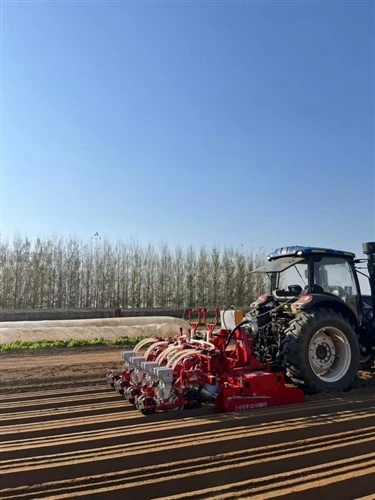
Carrot growers face similar economics. Carrot seed is often imported and can be costly, especially for high-value varieties. An air-suction carrot planter that singulates each seed and places it at the correct depth and spacing helps growers get the most from every kilogram of seed. The uniform plant stand that results also reduces the need for thinning and gap-filling, further lowering labor costs.
The economic benefits extend beyond seed savings. A vegetable seeder that places seeds uniformly produces a more uniform crop, which often commands a better price at market. Buyers prefer consistent sizes and shapes, and uniform spacing is the first step toward achieving that consistency. For onion growers, uniform spacing leads to uniform bulb size. For carrot growers, it leads to straight, well-formed roots.


Modern air-suction vegetable seeders also integrate multiple field operations into a single pass. Rotary tilling, ridge formation, drip tape installation, and seeding can all be completed in one operation, reducing fuel consumption and labor requirements. For farms facing tight margins, this integration is an important additional saving.
Our company, which holds 40 national patents related to pneumatic seeder technology, has exported air-suction vegetable seeders to Canada, Russia, Australia, and Central Asia. Growers in these markets report that the machines deliver reliable performance and rapid return on investment, largely because of the seed savings they provide.


For agricultural machinery wholesalers, the rising cost of hybrid seed is a strong selling point for precision seeding equipment. A vegetable seeder that saves seed, reduces labor, and improves crop uniformity is an easy product to recommend, because the economic benefits are visible within the first or second season. As seed prices continue to rise, the case for air-suction vegetable seeders becomes more compelling every year.


