

As spring ploughing gains full momentum across the globe, the race is on to maximize yields and secure food supplies. At the heart of this effort lies a quiet but profound transformation-the shift from traditional mechanical seeding to air-suction precision planting. This technological leap is not merely an incremental improvement; it is a complete redefinition of what modern seeding can achieve.

The Limitations of Traditional Seeders
For decades, farmers have grappled with the inherent flaws of conventional mechanical seeders. These machines, while functional, come with a host of challenges:
High miss-seeding and double-seeding rates lead to uneven plant spacing, forcing farmers to invest significant time and labor in manual thinning and replanting later in the season.
Mechanical seed damage is common, as moving parts crush or crack seeds, reducing germination rates and compromising crop uniformity.
Speed limitations restrict operational efficiency-at higher speeds, traditional seeders lose stability, making it difficult to complete sowing within tight weather windows.
Poor versatility means switching between different crops often requires complex part replacements and tedious adjustments, wasting valuable time.
These pain points have long been accepted as inevitable costs of farming-but they no longer have to be.


How Air-Suction Planters Are Different
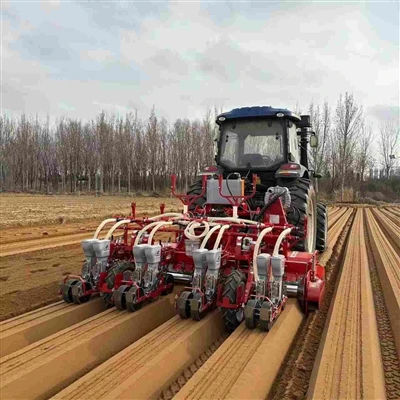
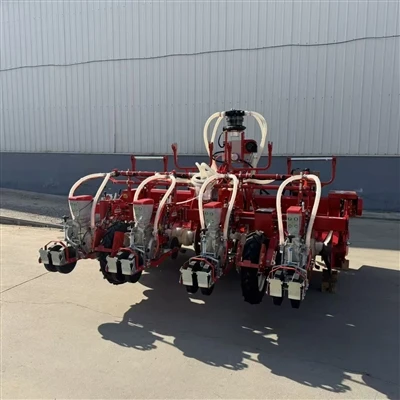
Air-suction precision planters operate on a fundamentally different principle: negative pressure airflow. A fan generates stable suction, allowing the seed plate to pick up individual seeds with remarkable accuracy. This simple yet sophisticated mechanism delivers a host of transformative benefits:
Gentle on Seeds – Airflow pickup eliminates mechanical extrusion, achieving a seed integrity rate of nearly 100%. Every seed is handled with care, preserving its full germination potential.
Significant Seed Savings – Single-seed precision sowing reduces seed consumption by 20%–30%, directly lowering input costs for farmers.
Exceptional Efficiency – These machines can cover over 200 acres per day, boosting operational efficiency by more than 30% compared to traditional models.
Unmatched Versatility – From onions and carrots to spinach and grains, simply changing the seed plate enables rapid crop switching-truly a one-machine-fits-many solution.

Measurable Results That Speak for Themselves
Field data confirms the superiority of air-suction planters. The plant spacing qualification rate exceeds 95%, while miss-seeding and double-seeding rates are drastically reduced. Emergence rates improve by over 15% compared to traditional seeders, eliminating the need for manual thinning and delivering substantial labor savings.
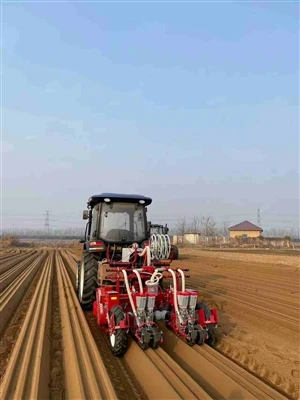
Moreover, these planters integrate multiple operations into a single pass-furrowing, fertilizing, seeding, soil covering, and compacting-all with millimeter-level depth control. Whether on flat plains or gently sloping terrain, seeding consistency remains flawless, laying the groundwork for strong, uniform seedlings and a potential yield increase of 10%–20% per acre.
From Experience to Data-Driven Precision
Agriculture is evolving. The old model-relying on experience and intuition-is giving way to a new era of data-driven precision farming. Air-suction planters are at the forefront of this shift, transforming seeding from a gamble into a science.
As the spring ploughing season enters full swing, demand for high-performance air-suction planters is surging. Manufacturers are ramping up production, delivering equipment that combines reliability, durability, and cutting-edge technology to meet the needs of large-scale farms and family operations alike.


A Commitment to Food Security and Rural Prosperity
The widespread adoption of air-suction precision planters is about more than just better equipment-it is about building a more resilient and productive agricultural future. By reducing seed waste, lowering labor costs, and increasing yields, these machines are making farming more sustainable and profitable.
In the grand symphony of spring ploughing, air-suction planters are playing a leading role-turning hope into harvest, one precise seed at a time. With continued innovation and a commitment to quality, they are poised to drive food security and rural revitalization for years to come.


