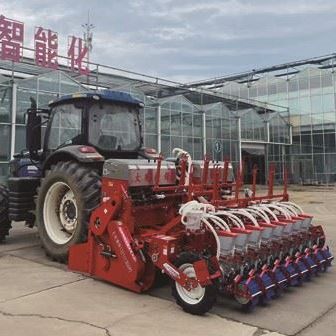
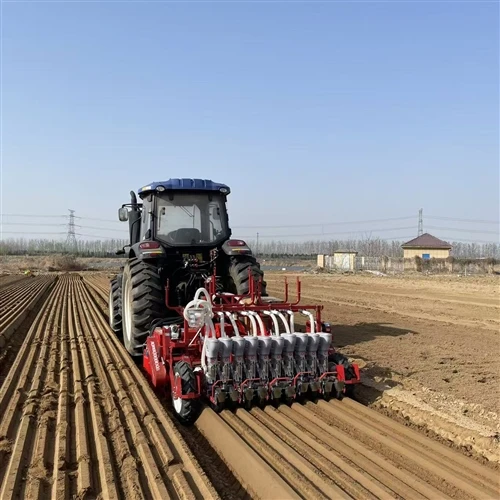
Vegetable Seeder Model Classification
Vegetable seeders can be divided into three main categories based on their level of automation:
Manual Seeder: Suitable for small-scale planting, affordable, easy to operate but less efficient.
Semi-automatic Seeder: Requires manual feeding, higher seeding precision, suitable for medium-sized vegetable gardens.
Fully Automatic Seeder: Integrates furrowing, sowing, and covering functions, increasing efficiency by 5-8 times, suitable for large-scale planting.
Mainstream Model Design Features
Different models of seeders have distinct structural features:
Roller Type: Uses a perforated roller to quantitatively distribute seeds. Suitable for small seeds such as radishes and spinach.
Air suction type: Utilizes negative pressure to adsorb seeds, resulting in better sowing uniformity and adaptability to seeds of different shapes.
Row sowing type: Uses a conveyor belt for continuous sowing, suitable for leafy vegetables requiring dense planting, such as lettuce and coriander.
Three golden rules for selection: Matching the machine model to your planting needs will yield better results:
Consider the terrain: Choose a model with anti-slip wheels for sloping land, and a heavy-duty model for flat land.
Consider the scale: Choose a machine for less than 5 acres, and a fully automatic model is recommended for more than 20 acres.
Choose seeds: Irregular seeds are best suited for air suction type, and small seeds are suitable for drum type.