


Product Description
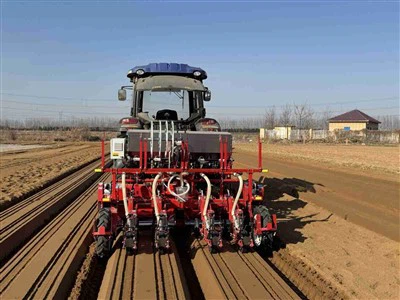
The 2DS-4H is a four-row pneumatic vegetable seeder built for precision planting in commercial vegetable production. This tractor-mounted implement is designed to establish crops such as beet, radish, Chinese cabbage, and onion with accurate seed placement across a moderate working width. The four-row format delivers a practical compromise between coverage and maneuverability, making it a solid choice for growers who need reliable multi-row planting capability without the bulk of larger implements.

Product Features
Pneumatic Metering System – The vacuum-operated seed metering controls the pickup and release of individual seeds across all four rows. This air-based system reduces the variability commonly associated with mechanical seed cups, particularly when handling small or unevenly shaped vegetable seeds. The result is more consistent spacing and better stand establishment.
Four-Row Configuration – The 2DS-4H is laid out with four planting rows, providing efficient coverage for medium-sized fields while remaining easy to handle during transport, headland turns, and storage. This configuration suits operations that need to balance planting output with equipment maneuverability.
Adaptable Seeding Setup – The metering components can be selected according to the specific physical characteristics of the seed being planted-size, shape, and any surface coatings. This adaptability allows the same base machine to shift between different vegetable crops simply by installing the appropriate metering plates and making the necessary adjustments.
Multi-Function Integration – Depending on the options specified, the machine can incorporate rotary tillage, bed shaping, drip tape laying, seeding, monitoring, and soil consolidation into one field pass. This integration reduces the total number of tractor runs across the field, lowering fuel consumption and labor requirements.


Seed Compatibility
The 2DS-4H is equipped to handle seed from a variety of vegetable crops including beet, radish, Chinese cabbage, and onion. When determining the correct metering setup, seed dimensions, shape profile, and surface treatment should all be taken into consideration. For crops not listed here, we encourage sending a seed sample for evaluation so the appropriate plate configuration can be verified before production.
Planting Configuration
The seeder can be adjusted to match the intended planting pattern, with variable settings available for row spacing, plant spacing, sowing depth, and seed metering tailored to the specific crop. These parameters should be established based on the target crop type, local cultivation practices, and the quality specifications required by the end market.
Tractor Compatibility
The tractor specification must align with the final machine configuration and the conditions in which it will operate. Buyers are asked to provide tractor horsepower, three-point hitch category, PTO speed rating, and hydraulic connection availability where relevant. A compatibility review is recommended before the order is finalized.
Tractor Compatibility
Proper tractor matching is essential to achieving optimal performance from any mounted implement. The seeder's efficiency in the field depends not only on its own design but also on the tractor's ability to supply adequate power, provide stable hydraulic flow (where required), and physically couple to the machine through the correct hitch configuration. We work with buyers to verify compatibility before production begins, reducing the risk of mismatched equipment that can lead to suboptimal performance or difficulty in the field.
Power Requirements – The horsepower needed to operate the seeder effectively depends on several factors beyond the basic machine specification. Soil type plays a significant role-heavy clay or compacted soils demand more power for tillage operations than light sandy soils. Working depth is another consideration; deeper tillage and ridge formation require greater drawbar and PTO power. The inclusion of optional equipment such as additional tillage tools or heavy ridging components also increases the power demand. While we provide a recommended minimum horsepower figure based on standard field conditions, the final power requirement should be assessed against the actual operating environment where the machine will be used.
Three-Point Hitch Category – The seeder is designed to connect to tractors via a standard three-point linkage. The specific hitch category required depends on the machine's weight, working width, and the lifting capacity needed to raise the implement for transport, headland turns, and depth control. We specify the correct hitch configuration for each machine model, but we also need to confirm that the customer's tractor is equipped with the corresponding category and has adequate lift capacity to handle the loaded implement-particularly when the hoppers are filled with seed and the machine is raised for transport.


PTO Speed Rating – The seeder's pneumatic and mechanical systems are driven through the tractor's power take-off shaft. The PTO output speed must match the machine's input requirement, typically 540 rpm or 1000 rpm depending on the configuration. Using an incorrect PTO speed can result in insufficient vacuum pressure for seed pickup, improper ground drive synchronization, or mechanical damage to the transmission components. We verify the specified PTO speed against the customer's tractor output before finalizing the order.
Hydraulic Connections – For configurations that include hydraulic-driven components-such as fold functions, depth control cylinders, or hydraulic drive options for the vacuum blower-we need to confirm that the tractor is equipped with the correct hydraulic outlets, flow rate capacity, and pressure rating. The number of required hydraulic circuits should be identified early in the ordering process to ensure the tractor can support all functions without the need for additional valve kits or adapters. Where hydraulic requirements are not clearly defined, we work with the buyer to establish the necessary specifications based on the machine configuration.
Additional Compatibility Considerations – Beyond the core specifications, other factors can affect tractor-machine compatibility. These include the tractor's wheel track width relative to the machine's working width, the distance from the PTO shaft to the lower hitch points, and the clearance required for the PTO driveline at extreme angles during turns. Tire size and configuration may also influence the machine's ground clearance and its ability to operate in ridged or furrowed conditions.
Pre-Order Compatibility Check – To avoid compatibility issues, we strongly recommend that buyers provide complete tractor details before production begins. The information we typically require includes tractor make and model, rated horsepower, three-point hitch category and lift capacity, PTO output speed(s) available, number of hydraulic outlets and their flow rates, and wheel configuration. With this information, our technical team can verify that the machine specification aligns with the tractor's capabilities and recommend adjustments where necessary. This pre-order check helps ensure that the equipment arrives ready to work, rather than requiring modifications or additional adapter parts after delivery.
Customization
Final specifications should be reviewed and confirmed before production begins. |


Quality Control
Each machine can be inspected before shipment to verify that it matches the confirmed order specifications. Inspection checks may include the seeding system, four-row layout, planting adjustments, drip irrigation components (if installed), monitoring equipment (where fitted), and all major working parts. Inspection reports or testing documentation can be provided upon request.

Packaging & Export
Export packaging is not a one-size-fits-all process-it is determined by the final machine specification, the shipping route, and the destination country's specific import and handling requirements. We treat each order individually to ensure that the machine arrives at its destination in the same condition it left the factory, ready for field operation without the need for repairs or part replacements due to transit damage.
Surface & Component Protection – All exposed metal surfaces, painted finishes, and sensitive components such as seed metering discs, vacuum chambers, and hydraulic fittings are treated with rust-preventive coatings and wrapped in protective materials before packing. This guards against moisture ingress, salt-spray corrosion during ocean freight, and abrasion from vibration during overland transport. For particularly sensitive items, we use additional padding and barrier films to ensure complete isolation from external elements.
Securing of Moving Parts – During transit, unsecured components can shift, leading to misalignment, scratching, or structural stress. All moving parts-including seeding units, press wheels, linkage arms, and PTO shafts-are firmly secured using industrial strapping, blocking, and bracing techniques. This prevents unnecessary movement inside the crate and reduces the risk of damage from load shifts during vessel roll or rough road handling.
Shipping Marks & Documentation – Each crate is clearly marked with handling instructions, destination address, order reference numbers, and any special symbols required by the carrier or customs authorities. This ensures that port personnel and freight forwarders can identify and handle the shipment appropriately at each stage of the logistics chain. All relevant documentation-packing lists, commercial invoices, bills of lading, and certificates of origin-is prepared in advance and either attached to the crate or provided digitally, depending on the buyer's preference and destination country requirements.

Inclusion of Operating Manuals – A complete set of operation and maintenance documentation is packed securely within the crate, typically in a weatherproof document holder placed in a clearly marked location. This allows the receiving party to access setup and adjustment instructions immediately upon unpacking, without waiting for separate document deliveries. Digital copies are also provided separately for convenience.
Supply of Agreed Spare Parts – Any spare parts ordered alongside the machine are carefully packaged and included within the main crate or in separate parcels as agreed. We take care to identify and separate consumable items from the main machine, ensuring that they are easy to locate upon arrival and that inventory checks can be carried out without unpacking the entire shipment.
Final Crate Dimensions & Shipping Weight – Before dispatch, we measure and record the exact dimensions and weight of each packed crate. This information is provided to the buyer and freight forwarder to facilitate accurate shipping cost calculations, container loading planning, and compliance with carrier weight limits. Where multiple units are ordered, we can also advise on container loading configurations to maximize space utilization and reduce per-unit shipping costs.
Throughout the packing process, we maintain clear records-including photos of the packed machine and crate-which can be shared with the buyer as part of the pre-shipment documentation package. This provides additional confidence that the machine has been correctly prepared for its journey.
After-Sales Support & Maintenance
We understand that reliable after-sales support is just as important as the machine itself, especially during critical planting seasons when downtime can have a direct impact on crop establishment and farm productivity. Our support framework is structured to provide timely, practical assistance that keeps your seeder operating at its best throughout its working life.
Operation Guidance – Every machine is delivered with comprehensive operating instructions that cover the essential steps for safe and effective use. This includes basic setup procedures, daily pre-operation checks, and guidance on adjusting key settings such as planting depth, row spacing, and seed metering rates. For visual learners, we also provide video walkthroughs that demonstrate common setup and adjustment tasks, making it easier for new operators to get up to speed quickly.
Routine Maintenance – Regular maintenance is the foundation of long-term machine reliability. We provide clear, easy-to-follow recommendations for the care of seeding units, pneumatic components, drive systems, and ground-engaging parts. This includes lubrication schedules, cleaning procedures, inspection intervals for wear-prone components, and guidance on when to replace items such as seed discs, scraper blades, seals, and bearings. Following these recommendations helps prevent unexpected breakdowns and extends the service life of the machine.
Troubleshooting Support – Even with proper maintenance, operational issues can occasionally arise. Our technical team is available to help diagnose and resolve common problems such as uneven seed spacing, vacuum pressure fluctuations, row unit blockages, or calibration drift. We provide step-by-step guidance to identify the root cause and implement corrective measures, minimizing downtime and getting the machine back into the field as quickly as possible.


Spare Parts Supply – We maintain stock of commonly required replacement parts to support fast turnaround on orders. This includes seed discs in various configurations, vacuum chamber seals, scraper assemblies, bearings, drive belts, chains, and press wheel components. For critical wearing parts, we recommend that customers order a baseline spare parts package alongside the machine to ensure immediate availability when needed. Express courier dispatch is available for urgent requirements to most global destinations.
Remote Technical Assistance – For installation, calibration, and operational adjustments, our support team can be reached through multiple communication channels including email, WhatsApp, and video calls. This remote capability allows us to provide real-time guidance during initial field setup, troubleshoot issues on-site without the delay of travel, and assist with seasonal changeovers between different crops. Our team works with operators directly, using photos, videos, and live video feeds to understand the situation and provide clear, actionable instructions.
Maintenance Documentation – Each machine is accompanied by a comprehensive set of operation and maintenance manuals. These documents cover technical specifications, assembly drawings, adjustment procedures, lubrication charts, and troubleshooting tables. Printed copies are included with the shipment, and digital versions are also available for convenient reference on tablets or phones in the field. For distributors and larger buyers, we can also provide documentation in local languages and customized formats to suit regional requirements.
Our after-sales support is built around the principle that every customer should feel confident in their ability to operate, maintain, and troubleshoot the machine independently, with our team standing by as a reliable backup when needed.
FAQ
Q: How do I determine which seeder is best for my seed type?
A: The selection process should take into account seed size, shape, weight, and any coating applied. We can help assess these factors and recommend the appropriate metering configuration.
Q: Can I send seed samples for testing before ordering?
A: Yes. If seed characteristics are unusual or likely to affect metering performance, we can arrange testing on representative samples prior to production.
Q: What distinguishes a seeder from a planter in vegetable production?
A: In general, a seeder is used for direct sowing of small seeds, while a planter is designed for larger seeds or transplanting seedlings at controlled intervals. The right machine depends on the crop and seed type.
Q: What criteria should I use when evaluating seeders from different suppliers?
A: Look at the metering mechanism, crop adaptability, configuration flexibility, build quality, testing procedures, parts availability, and the supplier's willingness to tailor the machine to your needs.
Q: Would a four-row seeder work well for contract planting work?
A: It can be a good fit if the four-row configuration aligns with the contractor's typical crop mix, field dimensions, tractor availability, and desired planting output.
Hot Tags: 4 row pneumatic vegetable seeder, China 4 row pneumatic vegetable seeder manufacturers, suppliers, factory, vegetable garden seeder, pneumatic vegetable seeder, vegetable seed planter machine, vegetable seed planter, 5 Row Pneumatic Vegetable Seeder, vegetable seed drill


